Golden Potato Casserole


Level 1: About as easy as this kind of recipe gets. Few ingredients, minimal cleanup, forgiving timing – a good way in if this type of recipe usually feels intimidating.
Level 2: Easier than most recipes of this type. Some technique, but nothing tricky. Minimal cleanup, forgiving timing. Think weeknights, a quick meal, or the easy version.
Level 3: About average for its category. Real judgment calls – tasting, timing, multiple components. Not a beginner recipe, but doesn't need to take over your afternoon or feel impossible for a decently quick dinner.
Level 4: More involved than the average recipe of its type. Multiple stages, careful timing, technique that matters. Worth setting aside the time and clearing the kitchen.
Level 5: The most involved this category gets here. Lots of components, real attention start-to-finish, multiple skills in play. The "I'm cooking today – bring me snacks but no questions" tier.
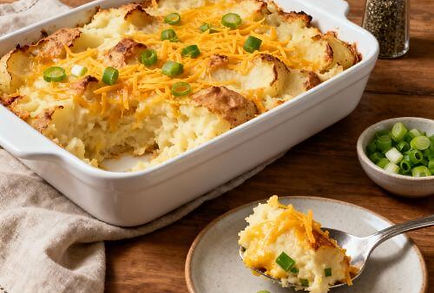
Tender potatoes, boiled in their skins, then chilled, grated, and folded into a melty cheddar and sour cream sauce with a hint of green onion, then baked until golden. It's twice-baked potatoes in casserole form: just as creamy and cheesy, but easier to make ahead, transport, and serve. Serves about 10, with a hands-off boil and chill before a 45-minute bake.
This has been my no-fail, go-to side for as long as I can remember – my mom and grandma both made it for holidays and family occasions. As I got older, I learned what twice-baked potatoes were and realized this is essentially that dish in casserole form: creamy, cheesy potatoes with a hint of green onion that are far easier to make, transport, and serve. Boiling the potatoes in their skins ahead of time does most of the work, so the casserole comes together quickly when you're ready to bake.

-
dry brine time:
-
marinade time:
-
hands-on time:
20 minutes
-
-
rise time:
-
cook time:
45 minutes
rest time:
-
chill time:
1 hour
total time:
2 hours 5 minutes
make-ahead friendly – boil and chill the potatoes (at least 1 hour, or overnight) before assembling and baking
reset to default # of servings
servings (≈1 cup per serving)
! see scaling note !
ingredients
Item
Quantity
Mise en Place / Notes
| russet potatoes | 4 | pounds |
boil, peel, and shred ( ≈3 cups ) |
| kosher salt (Morton) | 2 | tablespoons |
for salting the water |
| sour cream | 2 | cups | |
| cheddar cheese | 8 | ounces |
shredded ( ≈2 cups ) |
| unsalted butter | ½ | stick | |
| green onions (white & green parts) | 3 | stalks |
sliced ( ≈½ cup ) |
| additional salt and pepper | to taste | ||
| unsalted butter | ¼ | stick |
for dabbing on top |
ingredients
subRecipeName
Item
Quantity
Mise en Place / Notes
–
process
Mise en Place
–
–
–
–
1.
Boil the potatoes. Scrub about 4 pounds potatoes and leave the skins on. Put them in a large pot, cover with water by about 1 inch, and add the 2 tablespoons salt. Bring to a boil and cook until a knife slips into the center with no resistance, about 30 to 45 minutes depending on size. Drain and let cool enough to handle.
–
–
2.
Chill, peel, & grate. Chill the potatoes until cold, at least an hour. Cold potatoes firm up and grate into clean shreds instead of turning to mush. Slip off the skins, then grate the potatoes on the large holes of a box grater into a 9x13-inch baking dish.
–
–
3.
Slice the onions & shred the cheese. Thinly slice 3 stalks green onions, using both the white and green parts. Shred the 8 ounces cheddar if it didn't come pre-shredded.
–
Prepare
–
–
–
–
4.
Preheat the oven. Heat the oven to 350°F with a rack in the middle position.
–
–
5.
Make the cheese sauce. In a saucepan over low heat, stir ½ stick butter and the shredded cheddar together just until almost melted, then take the pan off the heat. Blend in 2 cups sour cream and the sliced green onions, and season with salt and pepper to taste.
–
–
6.
Mix it all together. Fold the cheese sauce into the shredded potatoes and stir lightly, just until the potatoes are evenly coated. Don't overmix, or the potatoes turn gluey.
–
Cook
–
–
–
–
7.
Dot with butter & bake. Scatter pats of butter over the top in small pieces. Bake at 350°F until the casserole is heated through and golden on top, about 45 minutes.
–
Serve
–
–
–
–
8.
Cool slightly & serve. Let the casserole rest for about 5 minutes, then serve warm.
–
if you have the thyme...
Here's where extra "thyme" pays off – layer in technique or ingredients to take this from "really good" to "wait, did you make this?" Pick one, stack a few, or save for next time.
- Crisp the top: run the finished casserole under the broiler for 2 to 3 minutes for a golden, bubbly crust – watch it closely so it doesn't scorch.
- Add a cheese lid: scatter an extra handful of shredded cheddar over the top for the last 10 minutes of baking for a melty, golden finish.
- Chill before grating: fully cold boiled potatoes grate into clean, distinct shreds and hold their texture – warm potatoes tear and turn gluey.
- Brown the butter: let the sauce butter cook until it just smells nutty before adding the cheese, for a deeper, toasted flavor.
- Make it a meal: fold in cooked crumbled bacon, diced ham, or roasted broccoli to turn this side into a main.
notes
Serving Suggestions
This makes a great side for so many things – BBQs, brisket, chicken dishes, ham, potlucks, and the list goes on...really you can't go wrong.
Substitutions & Variations
This is such a versatile dish – add bacon, ham, broccoli, green beans, or anything else you like for extra protein and flavor. Stir cooked add-ins into the cheese sauce when you fold in the potatoes; vegetables can go in raw or precooked, depending on how crisp-tender you want them.
Substitutions & Variations – Shelf-Stable & Frozen Ingredients
Use instant potatoes or frozen hashbrowns (see shortcuts). Sour cream can be frozen for baking (freeze in 1 cup increments or thaw the container overnight in the refrigerator). Cheese can be frozen either pre-shredded or as a block, thawed overnight, then shredded. Green onions can be pre-sliced, frozen, and used for this recipe straight from the freezer.
Substitutions & Variations – Keto-Friendly
Use 6 cups mashed cauliflower instead – roast frozen or fresh-cut cauliflower in the oven until soft, then puree in a food processor with a splash of cream or milk until it has the consistency of mashed potatoes. Mix with the other ingredients and bake until warmed through and slightly crispy on top, about 40 to 45 minutes.
Substitutions & Variations – Vegan & Dairy-Free
Replace the cheddar cheese with dairy-free cheddar or nutritional yeast and cashews. For the sour cream, replace with dairy-free sour cream.
Use vegan butter to replace butter at a 1:1 ratio.
Shortcuts
- Use frozen hashbrowns: thaw them slightly, then fold into the cheese sauce in place of the boiled-and-grated potatoes and bake as directed (about 45 minutes).
- Instant potatoes work too: prepare them per the package directions, fold in the other ingredients, and bake as directed. The casserole may be a little softer than one made with fresh potatoes, but it will still be delicious.
- There is no shame in using pre-shredded cheddar! It can have a slightly chalky texture on its own, but that is easily masked once it melts into the sauce.
- Pre-cut green onions (even frozen) work well here too.
Make It Ahead
- This is a great make-ahead dish for get-togethers. Assemble the casserole up to 2 days ahead, cover and refrigerate, then bake when you are ready to serve – straight from the fridge it will need close to the full 45 minutes, plus a few extra to take off the chill.
- It also freezes well for up to 3 months. Prepare through folding everything together, transfer to a freezer-safe pan, dot with the topping butter, and freeze covered. When ready to eat, bake from frozen until hot in the center and golden on top – this takes noticeably longer than baking fresh – or thaw overnight in the refrigerator and bake as directed.
Storage & Leftovers
Store leftover casserole covered in the refrigerator for up to 1 week. Reheat in the oven or microwave until warmed through.
scaling
Scaling a recipe up or down significantly? The recipe ingredients, process, cost, and nutrition scale (notes and faqs do not). Check yourself before you wreck yourself:
-
Tiny amounts get tricky. Very small quantities of yeast, baking powder, baking soda, and spices are easier to measure by volume (teaspoons) than by weight – your average kitchen scale can't reliably read tenths of an ounce.
-
Check your equipment. Make sure your bowls, pans, and mixer can handle the scaled volume. Dough typically needs 2 to 3 times its starting volume of space to rise comfortably.
-
Cook times don't always scale. Some steps – like cooking pieces one at a time in a skillet – take proportionally longer with a bigger batch. Others, like oven baking, usually stay about the same.
-
Hydration can drift. Flour absorbency varies, so very small or very large batches may need a splash more or less water than the math suggests.
Scaling Tips Specific to This Recipe
- Half batch: halve everything and bake in an 8x8-inch dish; start checking for hot and bubbly around the 30-minute mark.
- Bigger crowd: the recipe scales cleanly – double it across two 9x13 dishes rather than one deep pan, so it heats through evenly in about the same time.
- Watch the dish, not the clock: a deeper or fuller pan needs a few extra minutes. You're looking for heated through and golden on top, so let that be your guide.
- Season as you go: the salt and pepper in the sauce are a starting point – taste and adjust when you scale, since seasoning doesn't always scale 1:1.
faqs
What kind of potatoes work best for this recipe?
Russet potatoes are ideal because their high starch content gives a fluffy, light texture once they are shredded. Waxy potatoes like red or Yukon Gold are denser and can work, but the result will be heavier and less fluffy.
Can the potatoes be made ahead of time?
Yes. You can fully assemble the potato mixture in the casserole dish, cover, and refrigerate for up to 24 hours before baking. When you are ready to serve, let it sit at room temperature for about 20 to 30 minutes, then bake, adding a few extra minutes if needed until heated through and browned on top.
How do I avoid gluey or gummy potatoes?
The trick is to keep the potatoes cold and handle them gently. Boil them in their skins, chill them thoroughly, then grate them. Cold, firm potatoes shred cleanly instead of turning sticky, and folding the grated potatoes into the sauce just until they are coated keeps them light. Overmixing works the starch, and that is what makes potatoes gluey.
cost
10 servings (≈1 cup per serving)
| Ingredient | Per Serving | Total | |||
|---|---|---|---|---|---|
| russet potatoes | $ | 0.10 | $ | 1.00 | |
| salt | 0.01 | 0.10 | |||
| sour cream | 0.48 | 4.76 | |||
| cheddar cheese | 0.22 | 2.17 | |||
| butter | 0.04 | 0.38 | |||
| green onions | 0.03 | 0.28 | |||
| Total | $ | 0.87 | $ | 8.68 |
For a dish that feeds ten, this lands at right around $0.87 per serving – well under a dollar a plate, and under $9 for the whole 9x13. The surprise is where the money goes: it's the dairy, not the potatoes. Sour cream and cheddar together make up roughly 80% of the cost, with sour cream the single biggest line, while the potatoes come in at barely more than a tenth of the total. That makes this an easy one to shop smart on – buy cheese on sale (it freezes well as a block or pre-shredded), watch for deals on sour cream, and the humble potatoes will never break the bank.
nutrition information
serving size: 1 cup
| calories | 388 |
% daily value*
| total fat | 23.5 g | 30% |
| saturated fat | 14.7 g | 74% |
| trans fat | 0.6 g | - |
| polyunsaturated fat | 0.9 g | - |
| monounsaturated fat | 6.5 g | - |
| cholesterol | 68.8 mg | 23% |
| sodium | 185.0 mg | 8% |
| total carbohydrates | 35.1 g | 13% |
| dietary fiber | 2.5 g | 9% |
| sugars | 3.5 g | - |
| protein | 10.9 g | 22% |
micronutrients
| vitamin a | 203.8 mcg | 23% |
| vitamin c | 22.0 mg | 24% |
| calcium | 231.6 mg | 18% |
| iron | 1.5 mg | 9% |
| vitamin d | 0.6 mcg | 3% |
| magnesium | 50.1 mg | 12% |
| potassium | 844.3 mg | 18% |
| zinc | 1.5 mg | 14% |
| phosphorus | 294.6 mg | 24% |
| thiamin (b1) | 0.2 mg | 17% |
| riboflavin (b2) | 0.2 mg | 18% |
| niacin (b3) | 2.6 mg | 16% |
| vitamin b6 | 0.6 mg | 34% |
| folic acid (b9) | 41.5 mcg | 10% |
| vitamin b12 | 0.4 mcg | 16% |
| vitamin e | 0.6 mg | 4% |
| vitamin k | 14.0 mcg | 12% |
* Percent Daily Values are based on a 2,000-calorie diet; your needs may differ.
Nutrition information is estimated using USDA databases and may vary based on ingredient brands and preparation methods.
The 2,000-calorie reference is used as a general guide. Individual calorie needs typically range from 1,600 to 2,400 calories per day for adult women and 2,000 to 3,000 calories per day for adult men, depending on age, activity level, and other factors.
Let's be honest about what this is: a rich, cheesy comfort-food side, and it's happiest in that role. A serving runs about 388 calories, and most of the indulgence comes from the sour cream, cheddar, and butter – that's also where the saturated fat lives, so it pairs best with a lean main and something green on the side. The potatoes bring a little fiber and a good hit of potassium, and sodium stays moderate since most of the salt is in the cooking water rather than the finished dish. Treat it as the cozy splurge it is, and enjoy.
Cooked the Golden Potato Casserole?
Tell me about it. The good, the weird, the “I subbed apricots for peaches and somehow it worked.” Comments help me figure out which recipes are landing, give other home cooks a real sense of what to expect, and – not gonna lie – they make my whole day. It helps a lot.


SIMILAR RECIPES
Want to try a different side?


KITCHENARY
Learn the lingo...
·
vigorous bubbles, full churn
Rolling Boil

·
uniform, thin, straight-down cuts
Slice

·
-
Chill
·
long, thin strands, grater-style
Shred

·
-
Mise en Place
side · comfort food · vegetarian · gluten-free · kid-friendly · easy · make-ahead · minimal hands-on · potluck · holiday · family dinner · party · shallow fried · fall · winter · year-round
Edits to the Site (just in case you want to know)
June 9, 2026 – Rebuilt the method from the original family recipe card: the potatoes are now boiled in their skins, chilled, and grated, then folded into a cooked cheddar and sour cream sauce and baked at 350°F for about 45 minutes. Refreshed the headnote, quick description, cost and nutrition discussions, FAQs, and notes to match, and added Level Up and Scaling tips.
If this recipe is just so good that you have to share
...please use one of the links!